
The pursuit of a perfect smile isn’t a modern luxury; it is a human obsession that predates the pyramids. From ancient mummies to NASA-engineered “smart” metals, the evolution of orthodontics is a story of incredible engineering, surprising materials, and the relentless pursuit of the “Investment Smile.”
Ancient Origins: Catgut, Gold, and Fingers
The first “orthodontists” didn’t have clinics; they had burial rituals and basic tools.
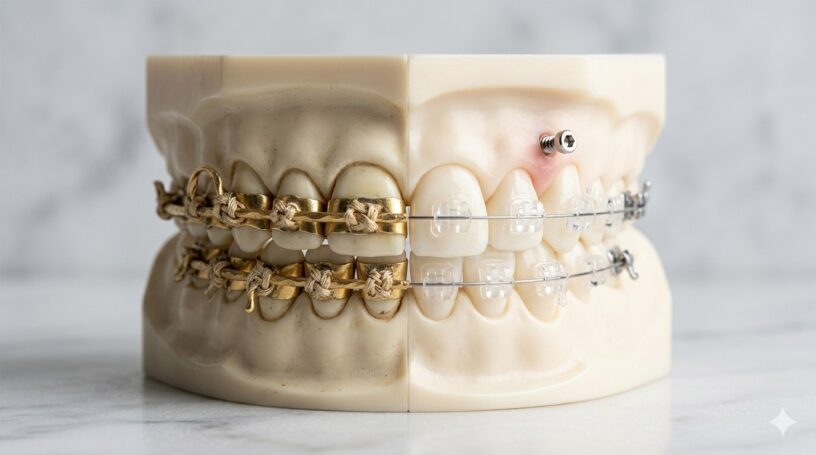
- Ancient Egypt: Archaeologists have found mummies with crude metal bands wrapped around teeth. To move them, they used catgut (cords made from animal intestines) to create tension—often intended to ensure the deceased looked their best in the afterlife.
- The Roman “Digital” Method: Around 25 BC, the Roman writer Aulus Cornelius Celsus recorded the first orthodontic treatment: applying firm finger pressure to a newly emerging tooth every day to guide it into place.
- The Etruscans: These ancient Italians were found with gold bands used to maintain space and prevent teeth from collapsing—a primitive version of today’s “space maintainers.”
The Enlightenment: Silk and Silver (1728–1819)
After the Middle Ages, France became the epicenter of dental innovation.
- The Bandeau (1728): Pierre Fauchard, the “Father of Modern Dentistry,” invented a horseshoe-shaped piece of precious metal (gold or silver) tied to teeth with silk threads. It was used to expand the arch and was remarkably similar in concept to our modern expansion tools.
- The Wire Crib (1819): Christophe-Francois Delabarre created the first precursor to modern braces: a woven wire “cage” that fit over teeth to hold them in place.
The 1900s: The “Heavy Metal” Era
Edward Angle (The Father of Modern Orthodontics) finally turned the craft into a science by classifying “malocclusions” (bad bites).
- Wrapping Every Tooth: Before modern “glue,” orthodontists had to wrap a metal band around every single tooth and solder brackets onto them. It was bulky, difficult to clean, and earned the nickname “metal-mouth.”
- The Gold Standard: High-end treatment often used 14k or 18k gold for wires because it was flexible. While regal, it made braces a luxury only the ultra-wealthy could afford.
The Modern Frontier: Specialized Marvels
Today, we use technology that would have seemed like science fiction just a few decades ago.
1. The Clark’s Twin Block: Engineering Growth
Developed by Dr. William Clark in 1977, the Twin Block revolutionized how we treat jaw alignment. Unlike previous bulky functional appliances, the Twin Block consists of two separate plates (upper and lower) that work together.
- The Mechanism: The plates feature angled “bite blocks” that interlock. When the patient bites down, the appliance encourages the lower jaw to sit in a more forward, ideal position.
- The Benefit: It harnesses the natural power of the patient’s own muscles and growth spurts to correct deep bites and receding chins, often preventing the need for later surgery.
2. Lingual Braces: The Invisible Investment
Invented in the 1970s by Dr. Craven Kurz, these are placed on the back (lingual side) of the teeth. Modern lingual systems use 3D scans to custom-cast each bracket in gold or medical-grade steel to fit the unique “landscape” of your inner teeth, making them completely invisible from the front.
3. NASA “Smart” Wires
The wires in modern braces are often made of Nitinol (Nickel-Titanium), an alloy developed by NASA for the space program. These “shape-memory” wires use your body heat to stay flexible while “remembering” their original shape, moving teeth more gently and efficiently than old stainless steel wires.
4. TADs & Expanders: Shaping the Bone
- TADs (Temporary Anchorage Devices): Tiny titanium screws placed in the bone that act as “anchors.” They allow orthodontists to move specific teeth without causing unwanted movement in others.
- Palatal Expanders: These “stretch” the upper jaw to create space and fix crossbites. Modern versions can now be anchored by TADs, allowing adults to achieve results that previously required jaw surgery.
5. 3D Printing & AI
We are now in the era of Clear Aligners. Using AI-driven software, we can predict exactly how bone will remodel and 3D-print a series of custom trays that are virtually invisible and removable.
Fun Facts
- NASA in Your Mouth: The same technology used to deploy solar panels in space is the same tech keeping your teeth moving 24/7.
- It’s Greek to Me: The word “orthodontia” comes from the Greek orthos (straight) and odont (tooth). It was coined in 1841.
- The 25% Club: One in four orthodontic patients today is an adult. It is truly never too late to invest in your alignment.
- The Weight of History: Early appliances were so heavy they often caused jaw fatigue; today’s materials are so light you’ll often forget they are there.

Leave a Reply